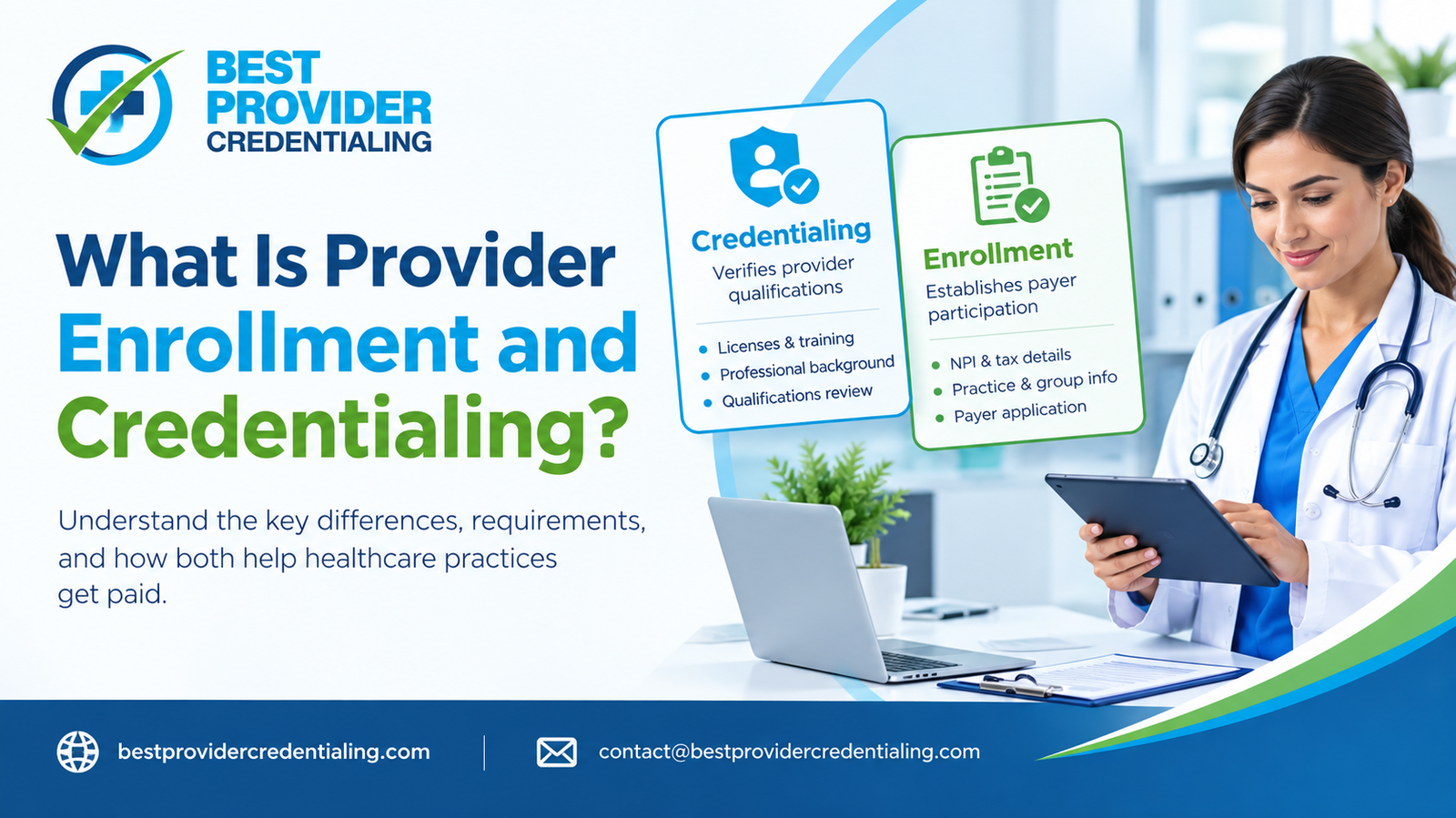
Provider enrollment and credentialing are two essential processes that help healthcare providers qualify to participate in insurance networks and receive reimbursement for covered services. Although these terms are often used together, they serve different purposes. Credentialing verifies a provider’s qualifications, professional background, and eligibility to deliver care, while provider enrollment establishes the provider’s participation with a health insurance payer.
For medical practices, understanding provider enrollment and credentialing is important for managing payer applications, avoiding administrative delays, and preparing to bill for covered services. Both processes require accurate information, appropriate documentation, and ongoing follow-up.
Best Provider Credentialing helps healthcare practices navigate provider credentialing, insurance enrollment, and related administrative requirements so they can manage payer participation more efficiently.
What Is Provider Credentialing?
Provider credentialing is the process of verifying a healthcare professional’s qualifications, education, training, licenses, certifications, work history, and other relevant professional information. Health insurance companies use this information to assess whether a provider meets their participation requirements.
Depending on the provider’s specialty and the payer’s requirements, credentialing may involve reviewing:
- Active state medical or professional licenses
- Education, residency, fellowship, and training records
- Board certifications, when applicable
- National Provider Identifier (NPI)
- Professional liability or malpractice insurance
- Work history and professional references, when required
- Sanctions, exclusions, and other relevant professional history
- Practice details and other supporting documentation
The exact requirements vary by provider type, specialty, state, and health plan.
Why Is Provider Credentialing Important?
Credentialing helps health plans verify that healthcare professionals meet applicable professional and participation standards. It also helps practices maintain accurate provider records and meet payer requirements.
Incomplete applications, expired licenses, inconsistent provider information, or missing documentation can delay the review process. Keeping records current and responding promptly to requests can help practices manage these issues.
What Is Provider Enrollment?
Provider enrollment is the process of registering a healthcare provider with a health insurance payer so the provider can participate in the payer’s program or network under the applicable terms.
Depending on the payer and enrollment type, the process may include submitting an enrollment application, providing practice and tax information, linking the provider to a medical group or organization, completing contracting requirements, and confirming the provider’s effective participation date.
Provider enrollment may involve Medicare, Medicaid, or commercial health insurance plans. Each program and payer has its own application procedures and requirements.
Common enrollment information and documentation may include:
- Individual and organizational NPI details
- Tax Identification Number (TIN) and W-9 information
- Practice addresses and service locations
- Ownership and authorized official information, when applicable
- Banking information for electronic funds transfer, when requested
- Professional license and liability insurance details
- Payer-specific enrollment forms and supporting documents
Not every payer requires the same documents or steps. Requirements depend on the provider, organization, payer, and type of enrollment.
Why Is Provider Enrollment Important?
Provider enrollment helps establish the administrative and contractual relationship between a healthcare provider or organization and an insurance payer.
Without the appropriate enrollment and participation arrangements, a practice may experience delays in billing, claim processing, or reimbursement. Before billing for services, practices should confirm the applicable payer requirements, provider and group affiliations, and effective dates.
What Is the Difference Between Provider Enrollment and Credentialing?
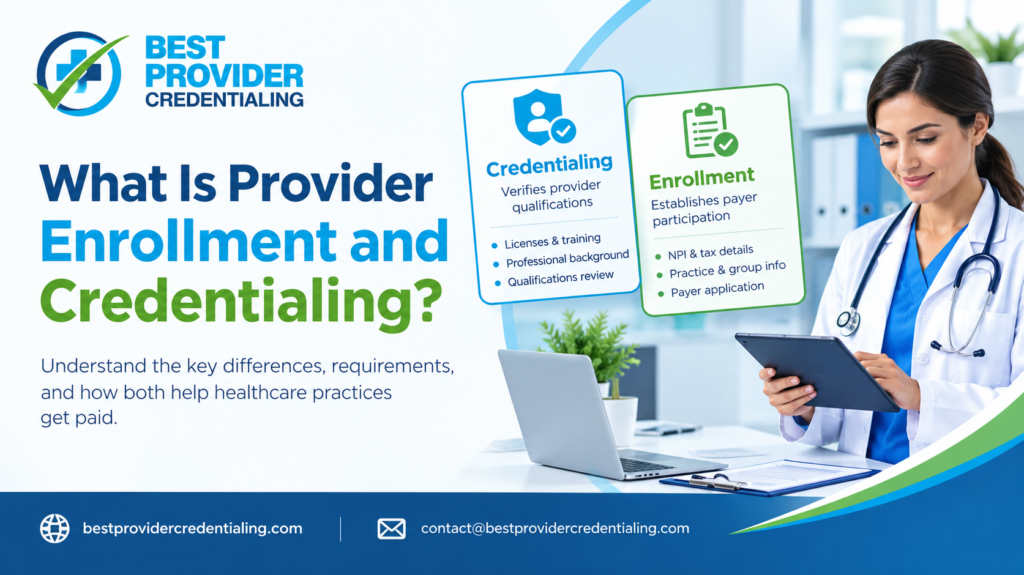
The main difference between provider enrollment and credentialing is their purpose. Credentialing verifies a provider’s professional qualifications, while enrollment establishes the provider’s participation with an insurance payer.
Although the processes are closely related, completing one does not automatically mean the other is complete.
| Comparison | Provider Credentialing | Provider Enrollment |
| Primary purpose | Verify professional qualifications and eligibility | Establish participation with an insurance payer |
| Main focus | Education, training, licenses, and professional background | Payer registration, practice details, affiliations, and participation requirements |
| Typical information | Licenses, training records, certifications, and malpractice coverage | NPI, TIN, W-9, practice locations, and payer applications |
| Responsible parties | Payer credentialing teams and credentialing organizations | Payer enrollment teams, provider offices, and enrollment specialists |
| Main outcome | Credentialing review and determination | Enrollment or participation status under the payer’s requirements |
| Ongoing requirements | Recredentialing and updated professional information, as applicable | Revalidation, demographic updates, and other payer maintenance requirements, as applicable |
The precise steps and outcomes differ among Medicare, Medicaid, and commercial insurance plans.
How Do Credentialing and Provider Enrollment Work Together?
Credentialing and provider enrollment often form connected parts of the payer participation process. A provider may need to satisfy credentialing requirements and complete enrollment or contracting steps before the practice can bill under the applicable payer arrangement.
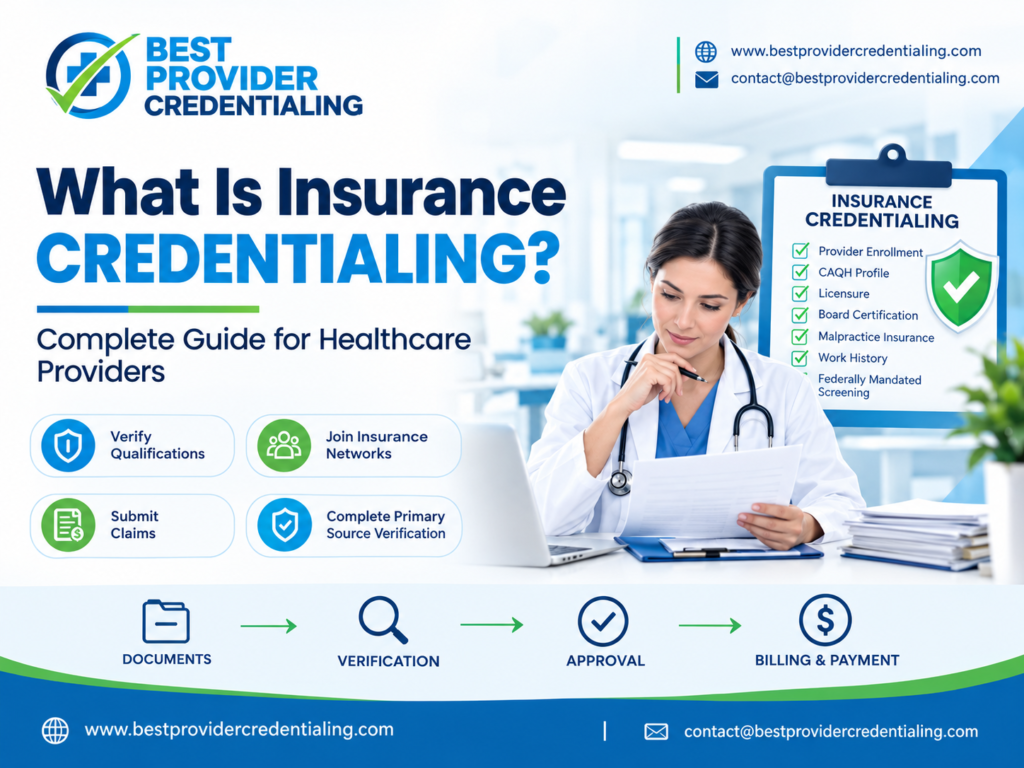
A typical process may include the following steps:
1. Collect Provider and Practice Information
Gather the provider’s professional credentials, licenses, NPI details, tax information, practice locations, and other documents required by the payer.
2. Review and Verify Credentials
The payer or its designated credentialing organization reviews the provider’s qualifications and supporting records against its requirements.
3. Submit the Enrollment Application
Complete the relevant payer enrollment application and provide required information about the provider, group, tax entity, and practice locations.
4. Complete Payer Review and Contracting Requirements
The payer reviews the application and may request corrections, additional documentation, or further action. Contracting may be a separate step for commercial plans.
5. Confirm Approval and Effective Dates
Track the application until the required participation steps are complete. Verify the provider’s status, applicable effective date, network participation, and billing requirements before submitting claims.
Important: The sequence is not identical for every payer. Some processes run concurrently, while others require one stage to be completed before another can proceed.
Which Comes First: Credentialing or Provider Enrollment?
Credentialing often precedes or forms part of the broader payer participation process, but there is no single sequence that applies to every insurance plan.
Some payers allow enrollment information to be submitted while credentialing is underway. Others require credentialing approval before completing contracting or final enrollment steps. Medicare and Medicaid also have program-specific enrollment and verification requirements.
Before beginning an application, practices should confirm the payer’s process, required forms, supporting documents, and submission sequence. This can reduce avoidable rework and help staff track the correct milestones.
Documents Required for Provider Enrollment and Credentialing
Accurate documentation is essential for both processes. Although the required documents overlap, credentialing generally focuses on professional qualifications, while enrollment also requires information about the provider’s business, tax identity, and payer participation.
Common documents and information include:
- Professional license: Evidence of an active license appropriate to the provider and jurisdiction.
- NPI: The provider’s individual NPI and, where applicable, the organization’s NPI.
- Education and training records: Relevant education, residency, fellowship, and certification details.
- Malpractice insurance: Current professional liability coverage information, when required.
- CAQH profile: An applicable profile with accurate information and required authorizations for participating health plans.
- W-9 and tax information: Information used to identify the provider’s or organization’s tax entity.
- Practice location details: Addresses, contact information, and service locations.
- Ownership and organizational documents: Records requested for the relevant entity or payer program.
- Payer application forms: Completed forms and supporting documents specific to the insurance plan.
This list is a starting point, not a universal checklist. Always confirm the current requirements of the relevant payer and program.
The Role of CAQH, NPI, TIN, and PECOS
Several identifiers and systems may be involved in provider enrollment and credentialing. Understanding their roles helps practices avoid confusing one requirement with another.
CAQH
CAQH ProView is used by participating health plans to collect and maintain provider professional information for credentialing. Providers may need to keep their profiles current and complete the authorizations required by the relevant health plans. A CAQH profile does not, by itself, complete every payer’s credentialing or enrollment process.
National Provider Identifier (NPI)
An NPI is a unique identification number for covered healthcare providers under applicable HIPAA requirements. Individual providers generally use Type 1 NPIs, while eligible organizations use Type 2 NPIs. The correct NPI information is important for payer applications and provider-to-group relationships.
Tax Identification Number (TIN)
A TIN identifies the individual or legal entity for tax purposes. Payers use tax and organizational information to establish the relevant billing relationship. Incorrect or inconsistent TIN details can lead to application corrections or delays.
PECOS
The Provider Enrollment, Chain, and Ownership System (PECOS) is the online system used for applicable Medicare provider and supplier enrollment activities. It is associated with Medicare enrollment, not a universal enrollment portal for all commercial insurance plans or state Medicaid programs.
Practices should use the appropriate system and follow the requirements for each payer and program.
How Long Does Provider Enrollment and Credentialing Take?
Processing times vary depending on the payer, provider type, application completeness, verification requirements, contracting steps, and whether additional information is requested.
An application may take longer when supporting documents are missing, provider information does not match across records, a practice location is incorrect, or the payer requires clarification.
To help manage timelines:
- Review applications before submission.
- Keep licenses, insurance records, and provider profiles current.
- Confirm individual and organizational information is consistent.
- Respond promptly to payer requests.
- Follow up through the payer’s approved channels.
- Track application status, outstanding items, and effective dates.
Avoid relying on a single estimated timeline for every payer. Confirm current processing expectations with the relevant insurance plan or government program.
Common Mistakes That Delay Credentialing and Enrollment
Small administrative errors can create avoidable delays. Practices can reduce the risk by checking the following areas before and after submission.
Incomplete Applications
Missing fields, signatures, or required attachments may result in requests for additional information or application returns.
Inconsistent Provider Information
Differences in names, addresses, NPI details, tax information, or organizational affiliations can require clarification.
Outdated CAQH or License Information
An incomplete provider profile or expired documentation may affect the credentialing review when the information is required.
Incorrect Provider-to-Group Association
A provider may need to be linked to the correct organization, TIN, or practice location. The required relationship should be confirmed with the payer.
Insufficient Follow-Up
Submitting an application is not the same as receiving approval. Practices should track status updates, outstanding requests, and next steps.
Billing Before Confirming Participation
Credentialing or enrollment progress does not necessarily mean a provider is approved to bill under a specific payer arrangement. Confirm the applicable approval status, effective date, network participation, and billing rules before submitting claims.
How to Track Applications and Confirm Effective Dates
A structured tracking process helps practices understand which applications are submitted, which require action, and which have reached the necessary approval milestones.
For each payer application, record:
- Provider name and NPI
- Insurance payer and plan
- Individual and group enrollment details, as applicable
- Submission date and reference number
- Current application status
- Outstanding documents or payer requests
- Date of the latest follow-up
- Approval status and effective date, once confirmed
- Any remaining contracting or billing setup requirements
Use payer correspondence or the payer’s official portal to verify status. Keep written confirmation of approval and effective dates where available.
An organized tracking system can help administrative teams prioritize follow-ups and reduce the risk of assuming that a submitted or approved application has satisfied every billing requirement.
Provider Enrollment and Credentialing Solutions for Healthcare Practices
Managing provider enrollment and credentialing internally can require significant administrative coordination, particularly when a practice works with multiple insurance plans, providers, and locations.
Best Provider Credentialing supports healthcare practices with credentialing and enrollment-related administrative services. Our team can help organize documentation, manage application workflows, monitor outstanding requirements, and follow up on payer applications according to the applicable process.
Our services can support practices with:
- Provider credentialing and recredentialing
- Commercial insurance payer enrollment
- Medicare and Medicaid enrollment support
- CAQH profile assistance
- Provider demographic and practice information updates
- Application status tracking and payer follow-up
- Enrollment maintenance and revalidation support, where applicable
The exact scope depends on the service requested and the payer or program involved.
Need support with provider enrollment and credentialing?
Contact Best Provider Credentialing to discuss your practice’s requirements and identify the administrative support that fits your needs.
Frequently Asked Questions
What Is the Difference Between Provider Enrollment and Credentialing?
Provider credentialing verifies a healthcare professional’s qualifications and professional background. Provider enrollment establishes the provider’s participation with an insurance payer under its applicable requirements. The processes are related, but completing one does not automatically complete the other.
Are Provider Credentialing and Provider Enrollment the Same Thing?
No. Credentialing focuses on verifying professional qualifications, while enrollment focuses on registering the provider with a payer and establishing the relevant participation details. Some payers coordinate the processes closely or combine parts of their workflows.
Which Comes First, Credentialing or Enrollment?
The sequence depends on the payer and program. Credentialing may need to be completed before final enrollment or contracting approval, while some payers allow parts of the process to proceed concurrently.
What Is Needed for Provider Enrollment and Credentialing?
Requirements vary, but common items include an active professional license, NPI details, education and training information, malpractice coverage when required, CAQH information when applicable, tax documents, practice locations, and payer-specific forms.
Does CAQH Complete Provider Enrollment?
No. CAQH ProView can help participating health plans collect provider information for credentialing, but it does not replace every payer’s enrollment application, contracting process, or other participation requirements.
Can a Provider Bill Insurance After Credentialing Approval?
Not necessarily. The practice should confirm the payer’s enrollment and participation requirements, effective date, provider-to-group relationship, and applicable billing rules. Credentialing approval alone does not guarantee that all billing requirements have been met.
How Can a Practice Reduce Enrollment Delays?
Practices can help reduce delays by submitting complete applications, maintaining accurate provider and practice information, responding promptly to payer requests, tracking outstanding requirements, and confirming approval and effective dates through official payer channels.
Can Provider Enrollment and Credentialing Be Outsourced?
Yes. Healthcare practices can use specialized service providers for administrative support with credentialing, payer enrollment, documentation, application tracking, and follow-up. Before outsourcing, confirm the service scope, communication process, security practices, and responsibilities for each payer application.