Introduction
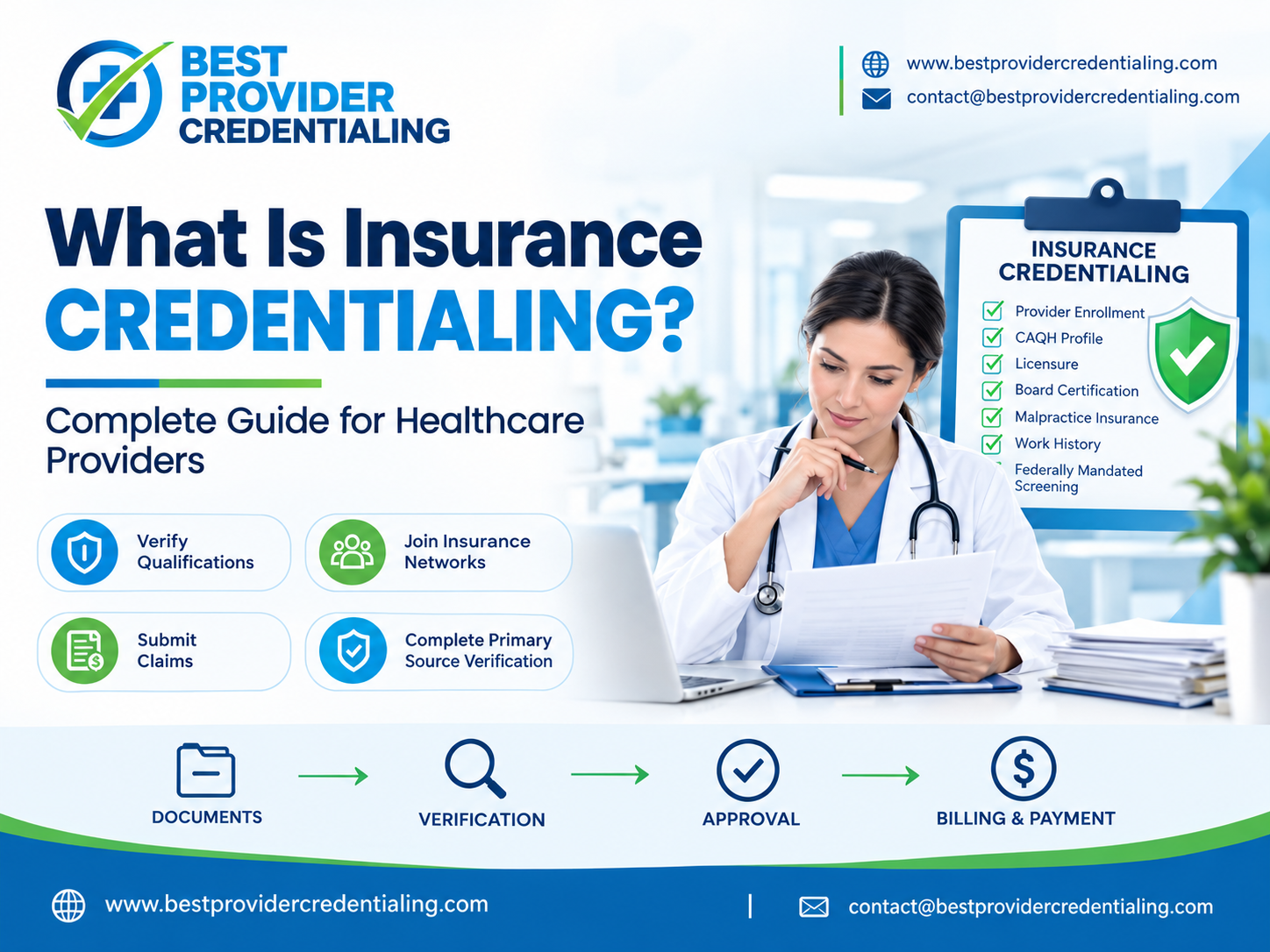
Insurance credentialing is an essential part of running a healthcare practice that works with insurance payers. Before a provider can participate in an insurance network, payers generally need to verify the provider’s professional qualifications, licenses, education, training, and other required information.
For healthcare practices, the credentialing process can involve multiple applications, CAQH updates, primary source verification, payer requirements, enrollment steps, and ongoing follow up. Small errors or missing information can create unnecessary delays and make provider onboarding more difficult.
Whether you are opening a new practice, adding a provider, expanding to new insurance networks, or managing an existing provider, understanding how insurance credentialing works can help you prepare the required information and manage the process more effectively.
In this guide, we explain what insurance credentialing is, how the process works, which documents may be required, how CAQH and Medicare enrollment fit into the process, common causes of delays, and how healthcare practices can maintain an organized credentialing workflow.
What Is Insurance Credentialing?
Insurance credentialing is the process health insurance companies use to verify a healthcare provider’s qualifications before approving the provider to participate in an insurance network.
The process typically involves reviewing professional licenses, education, training, board certification, work history, malpractice coverage, and other provider information. Payers use this information to determine whether a provider meets their participation requirements.
For healthcare practices, insurance credentialing is an important part of payer participation, provider enrollment, billing, and practice growth.
In simple terms: insurance credentialing verifies that a healthcare provider is qualified to participate with an insurance payer.
Credentialing can involve several steps, multiple organizations, supporting documents, and ongoing updates. A missing document, outdated CAQH profile, incomplete application, or unresolved verification issue can delay the process.
This guide explains the insurance credentialing process from start to finish, including CAQH, primary source verification, Medicare, Medicaid, provider enrollment, recredentialing, common delays, and practical ways to keep applications organized.
Why Is Insurance Credentialing Important?
Insurance credentialing helps payers verify that healthcare providers meet applicable professional and participation requirements before joining their networks.
For healthcare practices, successful credentialing can support:
- Insurance network participation
- Accurate payer enrollment
- In network provider status
- Proper claims processing
- Patient access to covered services
- Provider onboarding
- Practice expansion
- Revenue cycle operations
Credentialing is especially important when a practice is:
- Opening a new location
- Adding a new physician
- Hiring a nurse practitioner or physician assistant
- Adding a new specialty
- Expanding into new payer networks
- Starting or expanding telehealth services
- Recredentialing an existing provider
Starting the process early can help practices reduce administrative delays during provider onboarding.
What Does Insurance Credentialing Verify?
The exact requirements vary by payer and provider type, but credentialing commonly involves reviewing information such as:
- Medical education
- Residency and fellowship training
- Professional licenses
- Board certification
- Work history
- Malpractice insurance
- DEA registration when applicable
- Professional certifications
- Practice locations
- Provider identifiers
- Disciplinary or sanction information
- Other payer specific requirements
The payer may also verify information directly with primary sources rather than relying only on documents submitted by the provider.
This is known as Primary Source Verification, or PSV.
How Does the Insurance Credentialing Process Work?
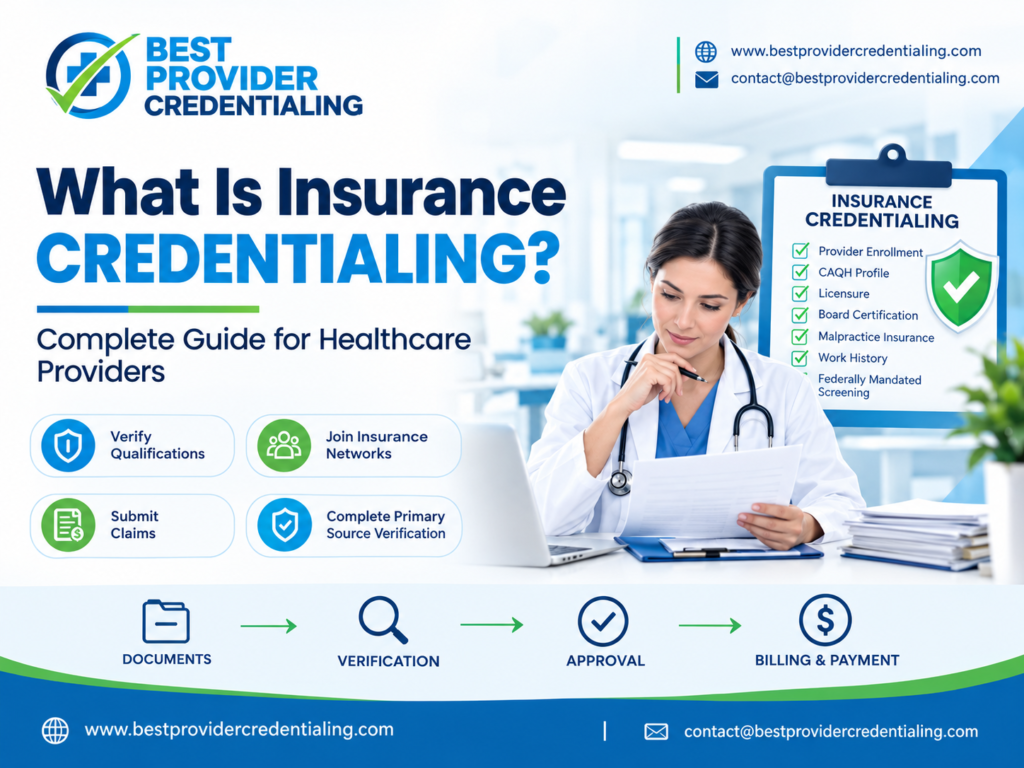
The insurance credentialing process can vary between payers, specialties, and provider types. However, a typical workflow includes the following steps.
Step 1: Gather Provider Information and Documents
Before submitting an application, collect the provider’s current information and supporting documentation.
Common documents may include:
- Individual NPI
- Organization NPI when applicable
- Tax identification information
- State medical licenses
- DEA certificate when applicable
- Board certification
- Medical school information
- Residency information
- Fellowship information
- Work history
- Malpractice insurance
- Practice locations
- Professional certifications
- CAQH information
Keeping documents organized before application submission can reduce avoidable back and forth with payers.
Step 2: Complete and Maintain the CAQH Profile
Many commercial health plans use CAQH data as part of their credentialing workflow.
The CAQH Provider Data Portal allows providers to maintain professional information and supporting documentation and authorize participating organizations to access their information.
A provider’s CAQH profile may include:
- Personal information
- Education
- Training
- Licenses
- Work history
- Practice locations
- Malpractice insurance
- Professional information
- Supporting documents
CAQH requires providers to periodically review and re attest to their information. The current CAQH provider guide states that re attestation is required every 120 days, or every 180 days for providers practicing in Illinois.
Keeping CAQH information current is therefore an important part of an effective credentialing workflow.
Step 3: Submit the Payer Application
Once provider information and supporting documents are ready, the application can be submitted to the appropriate payer.
Depending on the payer, the process may involve:
- Online payer applications
- CAQH authorization
- Provider enrollment forms
- Supporting documentation
- Contracting information
- Practice information
- Tax information
Every payer can have its own requirements, so practices should verify the current application requirements before submission.
Step 4: Primary Source Verification
Primary Source Verification is a key part of credentialing.
During PSV, credentialing teams verify provider information against the original or authoritative source.
Depending on the provider and payer, verification may include:
- Medical education
- Residency
- Fellowship training
- State licenses
- Board certification
- Work history
- Malpractice information
- Sanctions and exclusions
- Other professional credentials
If information cannot be verified or does not match the submitted application, the payer may request clarification or additional documentation.
Step 5: Payer Review
After the application and verification process, the payer reviews the provider’s information according to its credentialing requirements.
Additional information may be requested if:
- A document is missing
- A license has expired
- Work history contains unexplained gaps
- Information does not match
- A verification source has not responded
- Additional payer requirements apply
Promptly responding to requests can help keep the application moving.
Step 6: Credentialing Approval and Network Participation
Once the payer completes its review and approves the provider, additional network participation, contracting, or enrollment steps may still apply depending on the payer.
This is why credentialing and provider enrollment should not be treated as exactly the same process.
A provider may be credentialed while another administrative step is still required before the provider is fully active for billing with a specific payer.
What Documents Are Needed for Insurance Credentialing?
Document requirements vary by payer and provider type, but practices should generally be prepared to provide accurate and current information for:
Professional Identification
- Individual NPI
- Organization NPI when applicable
- Tax identification information
- Provider demographics
- Practice addresses
Education and Training
- Medical school information
- Residency
- Fellowship
- Graduation information
Licensure and Certification
- State medical licenses
- Board certification
- DEA registration when applicable
- Other professional certifications
Professional History
- Complete work history
- Previous practice information
- Explanations for applicable employment gaps
Malpractice Coverage
- Insurance carrier
- Policy number
- Coverage information
- Effective dates
- Expiration dates
Practice Information
- Practice locations
- Group information
- Specialty
- Contact details
- Billing information
Keeping these records updated can make future credentialing and recredentialing easier.
What Is CAQH Credentialing?
CAQH credentialing generally refers to the use of CAQH provider information as part of a payer’s credentialing workflow.
The CAQH Provider Data Portal allows healthcare providers to maintain their professional information and supporting documents and authorize participating organizations to access that information.
A complete CAQH profile can help organize information required for payer credentialing.
What Information Should Be Maintained in CAQH?
Providers should keep information such as the following accurate and current:
- Personal information
- Practice locations
- Education
- Residency
- Fellowship
- Licenses
- Work history
- Malpractice insurance
- Professional certifications
- Supporting documents
Expired licenses, outdated malpractice information, incomplete work history, and missing documents can create additional administrative work during credentialing.
How Often Does CAQH Need to Be Updated?
CAQH requires periodic re attestation to confirm that provider information remains accurate.
According to the current CAQH provider guide, providers generally need to re attest every 120 days, while providers practicing in Illinois follow a 180 day cycle.
Practices should also update their profile when important information changes, such as:
- A new license
- A new practice location
- Updated malpractice coverage
- Employment changes
- New certifications
- Other relevant provider information
What Is Primary Source Verification?
Primary Source Verification, or PSV, is the process of verifying provider credentials directly against the original or authoritative source.
For example, a payer may verify a professional license with the applicable licensing authority rather than relying solely on a copy submitted by the provider.
PSV may include verification of:
- Education
- Residency
- Fellowship
- Licensure
- Board certification
- Work history
- Malpractice coverage
- Sanctions and exclusions
Accurate provider information makes this stage easier to manage and can reduce unnecessary follow up.
Medicare Credentialing and PECOS
Medicare enrollment has specific requirements that differ from commercial payer credentialing.
CMS uses the Provider Enrollment, Chain, and Ownership System, known as PECOS, for Medicare enrollment management.
PECOS allows providers and suppliers to:
- Enroll in Medicare
- Review information on file
- Upload supporting documents
- Submit information electronically
- Revalidate enrollment
- Update enrollment information
CMS identifies PECOS as the online Medicare enrollment management system.
Medicare enrollment applications can also involve Medicare Administrative Contractors, or MACs, which process enrollment applications for applicable providers and suppliers.
Because Medicare enrollment has its own requirements, practices should treat Medicare enrollment as a distinct process that needs to be coordinated with the broader credentialing workflow.
Medicaid Credentialing and Enrollment
Medicaid requirements vary by state because Medicaid programs are administered at the state level within the federal and state framework.
Depending on the state and provider type, requirements may include:
- State specific applications
- Provider agreements
- Licensure verification
- Background checks
- Ownership information
- Supporting documentation
- Enrollment screening
Practices serving Medicaid patients should verify the requirements applicable to their state and provider type before submitting an application.
Insurance Credentialing vs Provider Enrollment
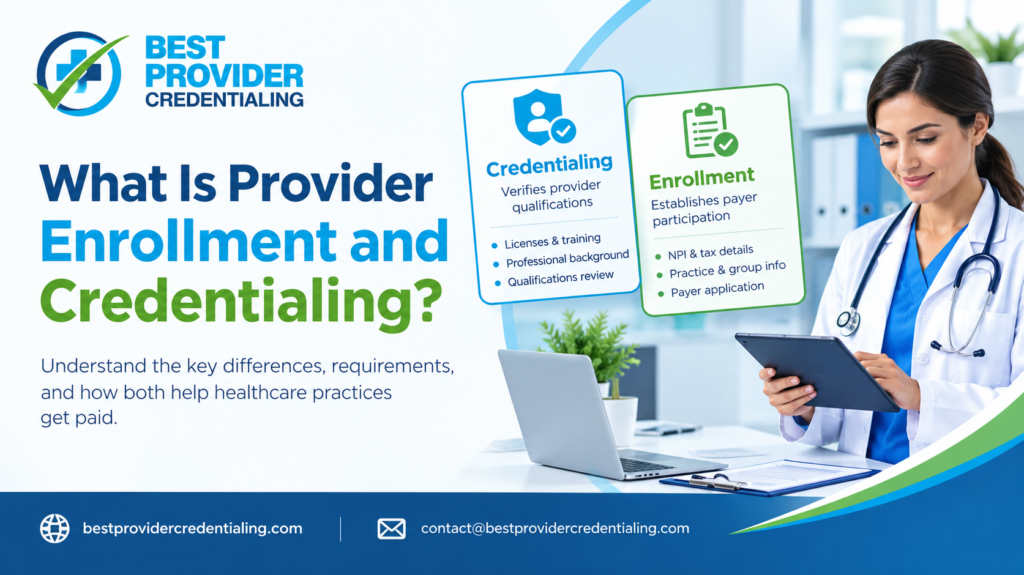
Credentialing and enrollment are related, but they are not interchangeable terms.
| Process | Main Purpose |
| Insurance Credentialing | Verifies the provider’s qualifications |
| Provider Enrollment | Establishes the provider’s participation and enrollment record with a payer |
| Contracting | Establishes contractual terms between the provider or group and payer |
| Privileging | Determines which services or procedures a provider may perform within a facility |
A complete payer participation workflow may require more than credentialing alone.
For this reason, practices should track credentialing, enrollment, contracting, and effective dates separately.
How Long Does Insurance Credentialing Take?
There is no single timeline that applies to every insurance credentialing application.
The time required can depend on:
- Payer requirements
- Provider specialty
- State requirements
- Completeness of the application
- Document availability
- Primary source verification
- Payer workload
- Contracting requirements
- Enrollment requirements
- Additional information requests
Rather than relying on a fixed number of days, practices should start the process early and maintain a tracking system for each payer application.
A useful credentialing tracker should show:
- Payer name
- Application date
- Application status
- Missing documents
- Verification status
- Follow up dates
- Contract status
- Enrollment status
- Effective date
- Next action
Common Reasons Insurance Credentialing Is Delayed
Many credentialing delays are administrative rather than related to the provider’s qualifications.
Common problems include:
Incomplete Applications
Missing information can result in additional requests and delays.
Expired Documents
Expired licenses, malpractice policies, or certifications can create verification problems.
Inconsistent Information
Differences between the CAQH profile, payer application, NPI information, and supporting documents may require clarification.
Incomplete Work History
Unexplained gaps or missing employment information can lead to additional verification.
Outdated CAQH Information
If a provider’s CAQH information or supporting documents are not current, the payer may not have the information needed for its review.
Delayed Follow Up
Applications often require follow up with payers, providers, verification sources, or other parties.
A centralized tracking process can help practices identify these issues earlier.
Can You Bill Insurance Before Credentialing Is Complete?
Practices should not assume that submitting a credentialing application automatically makes a provider eligible for in network billing.
Before billing, confirm the requirements that apply to the specific payer, provider, group, and service.
Depending on the situation, practices may need to confirm:
- Credentialing approval
- Provider enrollment
- Contract status
- Network participation
- Effective date
- Billing setup
- Payer specific requirements
Never assume that an application submission date is the same as the provider’s network effective date.
Insurance Credentialing for Different Provider Types
Credentialing requirements can vary depending on the provider’s specialty and payer.
Physicians
Physicians may need to provide detailed education, training, licensing, board certification, malpractice, and work history information.
Nurse Practitioners and Physician Assistants
Advanced practice providers may have additional state specific licensing and certification requirements.
Behavioral Health Providers
Behavioral health credentialing can involve specialty specific education, licenses, certifications, and payer requirements.
Dentists
Dental providers may have payer specific credentialing and participation requirements that differ from medical providers.
Other Healthcare Professionals
Each provider type should be evaluated according to the applicable payer and regulatory requirements rather than using one universal credentialing checklist.
Credentialing for New Practices
New practices should begin credentialing and enrollment planning before the anticipated launch date.
A new practice may need to coordinate:
- Individual provider credentialing
- Group enrollment
- Organization NPI
- Tax information
- Practice locations
- CAQH
- Commercial payer applications
- Medicare enrollment
- Medicaid enrollment
- Contracting
- Billing setup
Starting these activities early gives the practice more time to address missing information or payer requests.
Credentialing for Group Practices
Group practices often need to manage both individual provider information and organization level information.
When adding a new provider, the practice may need to coordinate:
- Provider credentialing
- CAQH updates
- Group information
- Payer applications
- Enrollment
- Contracting
- Effective dates
- Billing configuration
A centralized tracker can help prevent one completed step from being mistaken for full payer activation.
Telehealth and Insurance Credentialing
Telehealth providers still need to meet applicable payer, licensing, enrollment, and credentialing requirements.
Requirements can vary depending on:
- Provider type
- Payer
- State
- Practice location
- Patient location
- Service type
- Medicare or Medicaid participation
Healthcare practices should verify the requirements that apply to their specific telehealth model instead of assuming that traditional in person credentialing rules apply in exactly the same way.
What Is Recredentialing?
Recredentialing is the process of reviewing an already credentialed provider again to confirm that the provider continues to meet applicable payer requirements.
Recredentialing can involve reviewing updated:
- Licenses
- Board certifications
- Malpractice insurance
- Work history
- Professional information
- Practice locations
- Other credentialing documents
Practices should track recredentialing deadlines rather than waiting until documents expire.
How to Avoid Insurance Credentialing Delays
A strong credentialing workflow should focus on preparation, accuracy, and follow up.
1. Maintain a Master Provider File
Keep current provider information and supporting documents in one organized system.
2. Keep CAQH Current
Review provider information and supporting documents regularly and complete required re attestation.
3. Track Expiration Dates
Monitor:
- Licenses
- DEA certificates
- Board certifications
- Malpractice policies
- Other applicable credentials
4. Use a Payer Tracker
Track every payer application separately.
5. Follow Up Consistently
Do not assume that silence means the application is progressing.
6. Check Information for Consistency
Provider information should match across relevant records and applications.
7. Start Early
Credentialing, enrollment, contracting, and network activation can involve multiple steps. Early preparation gives practices more time to address issues.
Should You Outsource Insurance Credentialing?
Some healthcare practices manage credentialing internally, while others use an experienced credentialing service.
In house credentialing can work well when a practice has:
- Dedicated administrative staff
- Credentialing experience
- Strong payer tracking systems
- Time for regular follow up
- Processes for maintaining provider documents
Outsourcing may be useful when a practice:
- Is adding multiple providers
- Is expanding into new payer networks
- Has limited administrative staff
- Has difficulty tracking applications
- Needs help managing CAQH
- Wants centralized credentialing support
- Is experiencing repeated credentialing delays
The right approach depends on the size, specialty, payer mix, and administrative resources of the practice.
How Best Provider Credentialing Can Help
Best Provider Credentialing supports healthcare practices with provider credentialing and payer enrollment services across the United States.
Our services can support practices with areas such as:
- Provider credentialing
- Payer enrollment
- CAQH credentialing
- Medicare enrollment
- Medicaid enrollment
- Medical licensing
- Provider recredentialing
- Payer related administrative support
With 12+ years of combined experience, Best Provider Credentialing helps healthcare practices manage the administrative work involved in provider participation and enrollment.
For practices that want to reduce administrative workload and maintain a more organized credentialing process, professional credentialing support can provide a structured way to manage applications, documentation, follow ups, and payer requirements.
Insurance Credentialing Checklist
Before starting a credentialing application, make sure the following information is available and current:
Provider Information
- Individual NPI
- Organization NPI when applicable
- Tax identification information
- Provider demographics
- Practice locations
- Contact information
Education and Training
- Medical school information
- Graduation information
- Residency information
- Fellowship information when applicable
Licenses and Certifications
- Active state medical license
- DEA certificate when applicable
- Board certification
- Professional certifications
- License expiration dates
Professional History
- Complete work history
- Previous practice information
- Explanations for applicable employment gaps
Insurance
- Malpractice insurance
- Coverage information
- Policy number
- Effective date
- Expiration date
Payer Requirements
- CAQH profile completed
- CAQH information reviewed
- CAQH documents updated
- Payer application completed
- Supporting documents attached
- Enrollment requirements reviewed
- Contracting requirements reviewed
- Effective date requirements confirmed
Ongoing Tracking
- Application submission date
- Verification status
- Missing information
- Payer follow up dates
- Contract status
- Enrollment status
- Network effective date
- Recredentialing deadline
Frequently Asked Questions About Insurance Credentialing
What is insurance credentialing?
Insurance credentialing is the process health insurance payers use to verify a healthcare provider’s qualifications before approving participation in an insurance network.
How long does insurance credentialing take?
There is no universal timeline. Processing time can vary based on the payer, provider type, state requirements, application completeness, verification, contracting, and enrollment requirements.
What documents are needed for insurance credentialing?
Common documents include licenses, NPI information, education and training history, board certification, malpractice insurance, work history, practice information, and other payer specific documentation.
What is CAQH in insurance credentialing?
CAQH provides a centralized platform where healthcare providers can maintain professional information and supporting documents that participating organizations may access as part of their credentialing workflows.
How often does CAQH need to be updated?
CAQH requires periodic re attestation. The current CAQH provider guide states that re attestation is generally required every 120 days, or every 180 days for providers practicing in Illinois.
What is Primary Source Verification?
Primary Source Verification is the process of verifying provider credentials directly with the original or authoritative source.
What is the difference between credentialing and enrollment?
Credentialing focuses on verifying provider qualifications. Enrollment establishes the provider’s participation or enrollment record with a payer. Related processes can also include contracting and network activation.
Is Medicare credentialing the same as commercial insurance credentialing?
No. Medicare has its own enrollment requirements and uses PECOS for Medicare enrollment management. Commercial payers can have their own credentialing, contracting, and enrollment processes.
What is recredentialing?
Recredentialing is the process of reviewing an already credentialed provider again to confirm that the provider continues to meet applicable payer requirements.
Can a healthcare practice outsource credentialing?
Yes. Practices can manage credentialing internally or work with a professional credentialing service depending on their staffing, provider volume, payer mix, and administrative requirements.
Final Thoughts
Insurance credentialing is more than completing a payer application. It involves verifying provider qualifications, maintaining accurate information, managing CAQH, completing payer requirements, coordinating enrollment, tracking applications, and maintaining credentials over time.
The most effective approach is to start early, keep provider information accurate, organize supporting documents, monitor application status, and track payer effective dates carefully.
For practices that do not have the time or internal resources to manage these administrative responsibilities, professional credentialing support can help create a more organized and consistent workflow.
Best Provider Credentialing helps healthcare practices manage provider credentialing and payer enrollment requirements so their teams can spend more time focusing on patient care and practice operations.